

Financial System of Nepal
Following are the entities of the financial system of Nepal.
- Bank and financial institutions – Regulated by NRB
- Insurance companies – Regulated by Beema Samiti
- Capital Market – Regulated by SEBON
- Mutual Funds – Regulated by SEBON
- Cooperatives – Regulated by Sahakari Bhibag
- Contractual funds (Saving institution) – Regulated by Government of Nepal. For example
- Nagarik Lagani Kosh – Citizen Investment Fund
- Karmachari Sanchaya Kosh – Employee Provident Fund
- Samajik Surakchya Kosh – Social Security Fund
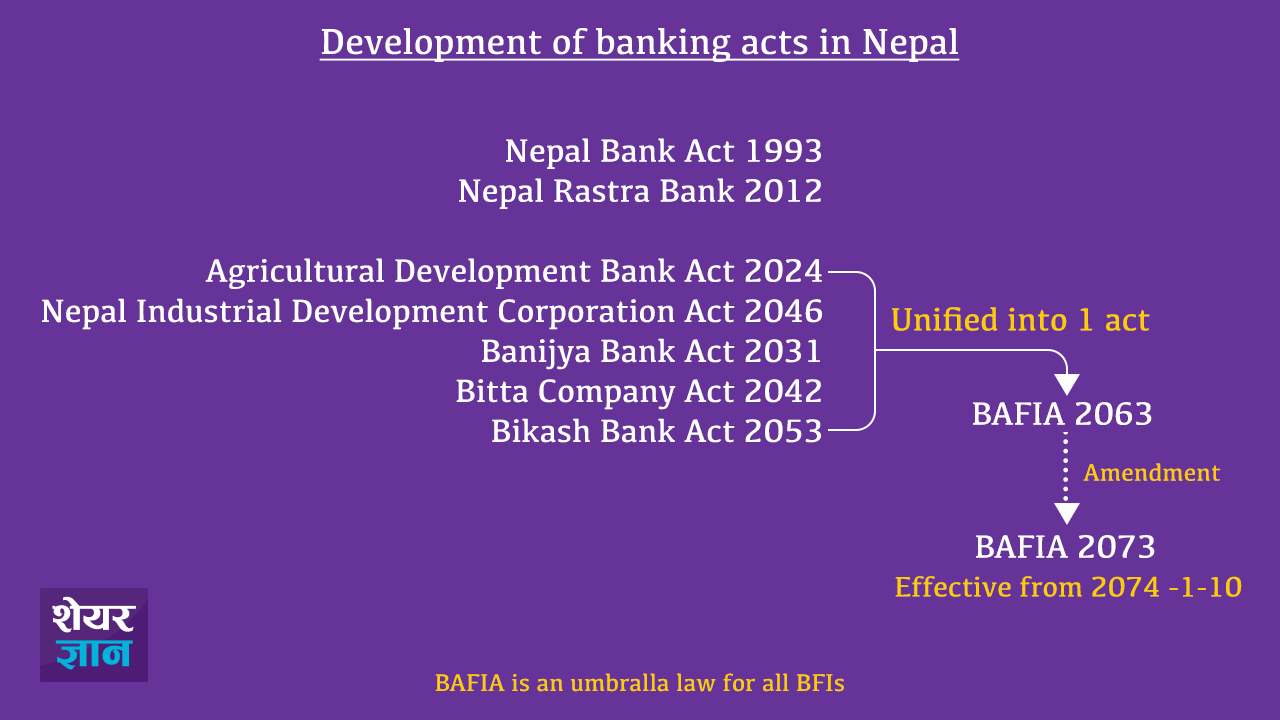
In Nepal, Bank and Financial Institutions are regulated as per the Bank and Financial Institution Act 2073 (BAFIA 2073).
Objectives of Bank and Financial Institution Act (BAFIA)
- To promote public trust towards BFIs.
- To promote reliable and quality banking in Nepal.
- To protect the rights and interests of the depositors and investors.
- To protect from banking hazards and protect from banking risks.
- To adopt economic liberalization for the development of the economic status of Nepal.
- To promote corporate governance and financial stability.
- To make legal provisions relating to incorporation, management, operation, and winding up of BFIs.
What are the Features of BAFIA 2073
Feartures लेख्दा हरुलाई आधार बनाएर लेख्नुपर्छ।
- BAFIA is an umbrella law.
- It is an integrated banking/regulating law.
- BAFIA focused on financial good governance.
- It focuses on maintaining the financial stability.
- BAFIA is in compliance with Money Laundering Prevention Act.
- Allow buyback of shares.
- Provision to incorporate BFIs only as a public company.
- Promote economic liberalization.
- Promote transparency and protection of deposits and depositors.
- Two types of winding up provisions are outlined such as Voluntary and Compulsory.
- BAFIA mentioned the prohibited functions of BFIs.
- BAFIA mandatory the use of KYC.
- BFIs must use external auditors and publish financial reports on time.
- Merger, acquisition of problematic BFIs.
- Special provision relating to infrastructure development bank.
- If there arise a conflict among BFIs then NRB’s decision will bea final decision.
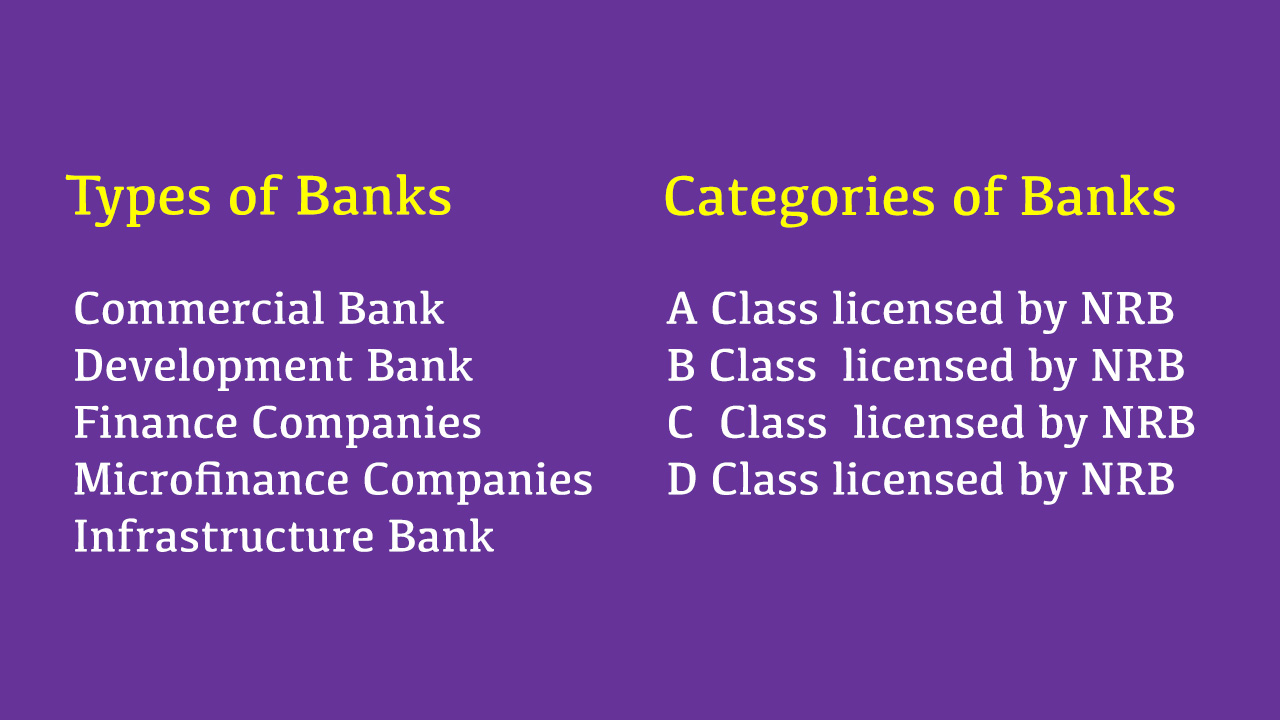
- BAFIA classifies BFIs into 5 types and 4 categories. Such as
Major Provisions of BAFIA 2073
1. It has a provision for the incorporation of BFIs
Before proceeding with the incorporation of Banks and Financial Institutions, it is necessary to get prior approval from Nepal Rastra Bank. Bank and Financial Institutions can be incorporated as a public company only. To get prior approval from the NRB, the following documents should be submitted.
- Memorandum of association (MoA).
- Article of association (AoA).
- Feasibility study report.
- Sustainability report.
- Individual details of the promotors.
- Tax clearance of promotors.
- Pre-incorporation contracts if any.
- Punishment status and clearance of the promotors.
- Source of income.
NRB shall provide approval within 120 days from the date of application submission. NRB can refuse to provide prior approval in the following conditions.
- Promotors are accused of criminal offenses such as Money Laundering, rape, banking offense, fraud, forgery, etc.
- If the proposed name is the same as previously registered BFIs.
- If the objective and functions stand against the prevailing law.
Incorporation of BFIs with joint venture or foreign investment need to get prior approval from the NRB. To expand branches, BFIs need to get prior approval from NRB. Incorporation of the BFIs is according to the company act.
2. It has a provision relating to the capital formation /share transaction
All the BFIs must submit their prospectus to NRB before issuing share capital.
BFIs must allot their capital as per the following structure.
- Minimum 30% for the general public.
- Minimum 51% for the promotors.
- Maximum 0.5 for the employees.
To make a share transaction, they must assign a share registrar and send notice it within the 7 days of an agreement.
The lock-up period for converting promotor shares into public shares is 10 years.
The lock u period for the transaction of promotor share is defined as 5 years and to make a transaction of promotor share who holds more than 2% share capital must get prior approval from NRB.
BFIs can buy back their share if the fulfill the necessary condition outlined by the law.
3. Provision relating to the buyback of shares
BFIs can buy back their share in the following conditions. (Explain Conditions, Procedure, and Method)
Conditions
- If AoA contains the provision of share buyback.
- If SGM make a resolution to buy back share capital.
- If the share capital is listed in the stock market.
- If a company is making a profit. (Can buy back only from profit)
- Only up to 20% of a general reserve fund.
Procedure
- Need to get prior approval from NRB.
- Submit the application to NRB with its rationale why, who, how much, where from and what rate? (buy back गर्नुको औचित्य देखाउनु पर्छ। )
- NRB approves the proposal or can refuse based on the document submitted.
- After getting approval from NRB, they must buy back share capital within 6 months from the date of approval or within 1 year from the date of special resolution.
- Method
- BFIs can buy the share either from the stock market or directly with the shareholder proportionally.
- After the buyback, they must deregister all the buyback shares within 120 days.
4. Provision relating to the transaction of securities
5. Provision relating to the BoD and Chief Executives
See – Functions, Duties and Rights of the Chief Executive.
6. Provision of license.
7. Provision relating to the operation of BFIs transactions.
8. Provision relating to the disbursement and recovery of credits.
9. Provision relating to the account, records, details, and reporting.
10. Provision relating to the merger and acquisition of BFIs.
11. Provision relating to the voluntary and mandatory liquidation of BFIs.
12. Provision relating to the actions, offenses, and punishment.
Background
As the number of banks and financial institutions increased rapidly, to control the number and increase the service quality, Bank and Financial Institution Ordinance 2061 (BAFIO 2061) was drafted in the tenure of King Gyanendra Shah. After issuing BAFIO, it categorized the BFIs into A, B, C, and D categories. Later after 2062/63 political changes, the parliament converted the ordinance into an act in 2073 and issued the Bank and Financial Institution Act 2073 (BAFIA 2073).
Ordinance (अध्यादेश ) – मन्त्रिपरिषदले बनाएको तर संसदमा पास नभएको ऐन कानुनलाई अध्यादेश भनिन्छ।
Probable Questions
- How does BAFIA promote Internal Control, Financial Governance, and Corporate Governance?
- What is the provision relating to the incorporation of BFIs as per BAFIA?
- What are the provisions relating to the capital formation of the BFIs?
- What are the provisions relating to the prior approval of BFIs according to BAFIA?
- Define the condition of share buyback according to BAFIA.
Visit Banking Gyan for banking exam-related resources.